

HHS and McMaster inspire the next generation of health researchers
High school students spent seven weeks over summer working with research teams at Hamilton Health Sciences (HHS) and our key academic partner McMaster University through the Secondary School Health Research Bursary Awards program. Launched in 2004 and hosted by HHS in partnership with McMaster, this program is designed for senior secondary school students interested in health, life sciences and research careers. Each summer, 15 students are awarded bursaries to shadow researchers and clinician scientists – such as hospital physicians involved in research — as they design, build and conduct studies aimed at prolonging lives and curing diseases.

Dr. Marc Jeschke
“Our Research Bursary Awards program is an investment in the future of health care,” says Dr. Marc Jeschke, HHS’ vice president of research and innovation, and chief scientific officer.
“Today’s bursary recipients are tomorrow’s physicians, researchers and health-care leaders. By creating meaningful opportunities for students to explore their interests and potential, we’re helping inspire the next generation of talent that will shape the future of care, research and innovation.”
Hear from four students about their experiences, and see our full list of 2026 bursary winners:
Gaea Robbins, Sir Winston Churchill Secondary School, Hamilton
“I’m pursuing my dreams in the medical field, to let other Indigenous kids know that a health-care career is an option for them.”
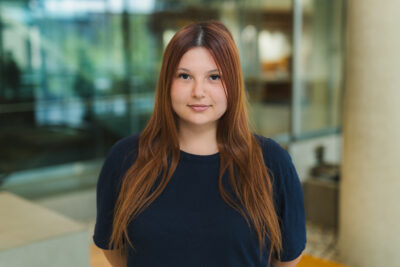
Gaea Robbins is the bursary program’s first Indigenous student
Gaea Robbins is a member of the Mi’kmaq Nation, and the first Indigenous student in the program’s 22-year history, says program organizer Donna Catherwood, HHS’ research program and events coordinator, and a member of Six Nations of the Grand River.
Gaea received a dedicated bursary for First Nations, Métis and Inuit students, established last year to encourage Indigenous applicants.
“I’m pursuing my dreams in the medical field, to let other Indigenous kids know that a health-care career is an option for them,” says Gaea, who wants to be a neurosurgeon or intensive care unit nurse.
“You don’t see a lot of Indigenous kids pursue these kinds of learning opportunities and I want to help change that,” adds Gaea, who was inspired to apply for the bursary program because of her lifelong visits to HHS McMaster Children’s Hospital. She was born with spina bifida occulta and also supported a close friend who was hospitalized due to a life-threatening illness.
“I really want to work in a hospital because of my own experiences,” says Gaea.
Her mentor, Dr. Alison Fox-Robichaud, is a critical care physician at HHS’ Hamilton General Hospital, a national sepsis expert and researcher, and HHS chair in sepsis research.
Fox-Robichaud has mentored a high school student every summer since the program started, and she championed the creation of a dedicated bursary for Indigenous students together with Catherwood and Indigenous community members working in health, research and education.
“HHS is a leading teaching hospital, and our dedicated bursary for Indigenous high school students provides early mentorship so they feel supported, inspired and empowered to explore careers in health care and research,” says Fox-Robichaud.
Gaea, who’s entering Grade 12, learned how to conduct a scoping review of biomarkers related to an experimental therapy for sepsis.
A scoping review brings together and evaluates the available research on a topic. It shows what’s already known, where more research is needed, and how the findings could help shape future research and policy. Gaea also got hands-on lab experience.
Sola Akinbola, Havergal College, Toronto
“Since I’m planning to study biology, I was grateful for the opportunity to gain exposure in the research field.”

Sola Akinbola (left) spent her placement in Dr. Alison Holloway’s (right) toxicology lab.
Sola will enter her first year at University of British Columbia in September, pursuing a bachelor of science degree. She’s especially interested in health research that improves outcomes for children and youth.
“Since I’m planning to study biology, I was grateful for the opportunity to gain exposure in the research field,” says Sola, who spent her placement in Dr. Alison Holloway’s toxicology lab at HHS’ McMaster University Medical Centre.
Holloway is a professor of obstetrics and gynecology, and her lab studies how exposure to certain chemicals during pregnancy and adulthood can lead to health problems in people as well as animals. Like Fox-Robichaud, Holloway has mentored a high school student every summer since the bursary program launched.
Sola’s project looked at how chemicals in wastewater from Alberta’s oil sands could affect male reproductive health. It was inspired by concerns from Indigenous communities, who observed declines in wildlife populations near areas of oil and gas development.
Sola studied reproductive cells from male mice, grown in the lab, to see how they responded when exposed to chemicals found in wastewater. As part of the project, she learned a laboratory technique called polymerase chain reaction (PCR), which helps researchers measure changes in gene activity.
She also learned to perform a test called a reactive oxygen species (ROS) assay, which determines whether the chemicals cause cells to produce harmful oxygen-containing molecules.
Her hands-on work also included learning pipetting, a laboratory technique used to prepare samples for analysis. She processed and analyzed data, created graphs using a laptop, and presented her findings at weekly research team meetings.
“It was really helpful to have members of the research team, including masters and PhD students, interpret what the data means,” says Sola.
Anya Sinha, Merivale High School, Ottawa
“The Hamilton Health Sciences Bursary Program was an opportunity for me to build on what I’ve learned in a research environment, with experts from different fields working together.”

Anya Sinha is interested in pain research. Her mentor, Dr. Tara Packham, is an occupational therapist and pain researcher.
Anya is entering her first year at the University of Ottawa, studying biomedical science. She spent her placement being mentored by Dr. Tara Packham, an occupational therapist and pain researcher at McMaster’s Interdisciplinary Movement and Pain Research in Translational Science (IMPRinT) lab. Packham co-founded the lab to develop new approaches to pain and movement care, drawing on insights from more than 25 years of treating patients at HHS.
The lab aims to improve the lives of people living with muscle, bone and joint pain by better understanding how pain affects movement. This knowledge helps researchers develop new and better approaches to rehabilitation. “I’ve been getting exposure to new and different kinds of research,” says Anya, who in high school started working as a research intern at a pain lab in Ottawa.

Dr. Tara Packham (centre)`steps up’ for research into Raynaud’s phenomenon by dipping her foot into ice-cold water while Anya Sinha (lfet) and Natalie Lobo (right) monitor her body’s reaction. Anya and Natalie were among 15 winners of secondary school health research awards, and spend their summer at McMaster’s IMPRinT lab, which Packham co-founded.
Her experiences at the IMPRinT lab included ‘stepping up’ to help with a study protocol design by dipping her toes in an ice-cold foot bath. This research into Raynaud’s phenomenon is being done in partnership with the HHS research and innovation team, to test a promising new product designed to help people with this condition manage pain.
Raynaud’s is a group of symptoms that include whiteness, blueness, redness and pain or prickling in the fingers, toes, ears or nose. It’s caused by a lack of blood to the affected areas and is usually brought on by cold.
“We recreated experimental conditions that would reproduce blood vessel spasms by placing a healthy person’s foot in ice water and monitoring the effect on their temperature regulation system,” says Packham. “We then monitored how the body’s temperature regulation system responded, measured how much it changed and how long those changes lasted.”
Anya’s experiences also included doing literature and scoping reviews on treatments for Raynaud’s, not involving medications.
“Pain research is something I’m very interested in,” says Anya, “The Hamilton Health Sciences bursary program was an opportunity for me to build on what I’ve learned in a research environment, with experts from different fields working together.”
Ishaan Grotra, Appleby College, Oakville
“I’ve learned a lot about how research projects are designed, the ethics behind research, and rules around patient privacy and personal health-care information.”

Grade 12 student Ishaan Grotra is interested in health care involving older adults.
Ishaan, who’s entering Grade 12, plans to study biomedical engineering at university. He was placed at HHS’ Juravinski Hospital and Cancer Centre’s Orthopedic and Fracture Clinic where his mentor was orthopedic surgeon and researcher, Dr. Thomas Wood.
Wood has mentored bursary winners for several summers, giving them a chance to observe surgeries in the operating room and shadow him during patient appointments in the clinic.
“These kinds of opportunities can shape a high school student’s future, inspiring them to pursue careers in medicine and research,” says Wood.

Ishaan Grotra scrubs up for observing a surgery as part of his placement experience.
Ishaan attended a hip-replacement surgery as part of a landmark, international research trial led by Wood, the principal investigator.
The PREVENT-iT (Prospective Randomized Evaluation of Emerging Novel Treatments for Infection Prophylaxis in Total Joint Replacement) trial is the largest orthopedic study ever conducted, and will involve 21,000 patients worldwide. Some 4,000 patients have already been enrolled, with close to half from HHS including the patient whose surgery Ishaan observed.
PREVENT-iT is exploring the safest and most effective approach for reducing serious infections after hip and knee replacement by looking at different antiseptic solutions used to rinse the surgical site, as well as whether placing an antibiotic powder directly into the wound during surgery further lowers the risk of infection.
“It was really cool to see this research in practice in the OR, because this study was integrated directly into the surgery,” says Ishaan, whose placement also included working on a study that uses AI and machine learning, enrolling patients in research studies and collecting data through follow-ups.
“I’ve learned a lot about how research projects are designed, the ethics behind research, and rules around patient privacy and personal health-care information,” says Ishaan, who’s especially interested in health research involving older adults.
“This placement really fit me well because a lot of the people visiting the clinic and getting hip and knee replacements are older.”
Celebrating success: 2026 bursary winners
Students receive a $1,500 award at a ceremony to mark the completion of their placement.
Congratulations to our bursary students, and thank you to their mentors:
- Ayra Akhtar, Thorold (Dr. Derek Chu, allergy and clinical immunology)
- Sola Akinbola, Hamilton (Dr. Alison Holloway, toxicology)
- Agaas Arora, York, (Dr. Colin Kretz, cardiovascular health)
- Jenna Bae, Richmond Hill, (Dr. George Ioannidis, geriatrics)
- Heather Barkman, Brantford (Dr. Mathew Leonardi, gynecology, endometriosis)
- Tristan Barkman, Brantford (Dr. Sandy Raha, basic biomedical – reproductive biology and environmental toxicology)
- Deena Farrukh, Brampton (Dr. Flavia Borges, perioperative medicine)
- Jessica Gill, Brampton, (Dr. Sandra Ofori, cardiovascular/perioperative)
- Ishaan Grotra, Oakville (Dr. Thomas Wood, orthopedics)
- Siyoon Kim, London (Dr. Derek Chu, allergy and clinical immunology)
- Sophia Lin, Mississauga (Dr. Jeffrey Pernica, pediatrics)
- Natalie Lobo, Mississauga (Dr. Tara Packham, rehabilitation)
- Gaea Robbins, Hamilton, (Dr. Alison Fox-Robichaud, critical care and sepsis)
- Lillian Shen, Richmond Hill, (Dr. Marc Jeschke, burns)
- Anya Sinha, Ottawa (Dr. Tara Packham, rehabilitation)
Bursary awards support their post-secondary education.


